 Dávid Bárdos


 My Computer
 Categories
 Network neighborhood
 Degoogling
 Chevron-locked games
 Along the Edge OST
 My Everyday Superpower
 Date Day
 Five Curious Habits of My Poodle
 The Z323 said goodbye
 My very first blog
 Memories Taken by the Heat
 Bombanana!
 Blaugust 2026
 The fifth grandmother
 Replacing Instagram: EyeSpace
 Mobile OSes (featuring Fairphone 5)
 Daily sparks - May 2026
 Who knows that you blog?
 I dream of...
 Intersecting interests
 Along the Edge
 My oldest things
 My Phones
 Road 96 - My Journey
 Custom Font in JetBrains Terminal
 Snowfall
 Refactoring: Yeelight GUI
 Gaming backlog
 Clean patching
 About Gridranger
 Friendships in my life
 Intro through traits
 Video games that made me learn
 Family history
 Random facts about me

How I dash🔗
Reading the em dash conununundrum by scribblans and Em dashes by David brought my unusual relationship with these punctuation marks to the surface.
Let's start with how my native language typesets dialogues differently from English. They are typed like this:
📖 Antal Szerb: The Pendragon Legend, translated by Len Rix
– Tell me – he asked, with some embarrassment, as we strolled along: –, you’re a bloody German, aren’t you?
– Oh, no. I’m Hungarian.
– Hungarian?
– Hungarian.
– What’s that? Is that a country? Or are you just having me on?
– Not at all. On my word of honour, it is a country.
– And where do you Hungarians live?
– In Hungary. Between Austria, Romania, Czechoslovakia and Yugoslavia.
– Come off it. Those places were made up by Shakespeare. – And he roared with laughter. – Alright, so you’re a Hungarian… Good country, that. And what language do you Hungarians speak?
– Hungarian.
– Say something in Hungarian.
It was some years since I had last spoken the language and, strangely moved, I recited some Ady:
– Mikor az ég furcsa, lila-kék
S találkára mennek a lyányok,
Ó, be titkosak, különösek
Ezek a nyári délutánok.
(Under a strange, lilac-blue sky / The girls stroll to their assignations; / Mysterious, enigmatic / Summer afternoons.)
– Very nice. But you don’t fool me. That was Hindustani. It means: „Noble stranger, may the Gods dance on your grave in their slippers.” I’ve heard that one before. However, since you’re the first Hungarian I’ve met, let’s do something to celebrate this splendid friendship.
Those are en dashes. Since there is no button for them on the keyboard, non-technical people struggle to type them on PC. The most common text editor, Word has some automation to replace hyphens with them. But it doesn't handle every situation well. This functionality is sometimes buggy in newer Word versions, and even on old versions, it worked only with the correct locale settings. In Word, the secret combo, Ctrl+NumPadMinus, fixed that issue for me back then.
But, as I wrote earlier, I had ambitions to be an author at the same time I was learning to write HTML. Of course, I wanted to type the right characters on web pages too, so I learned the HTML codes for them together with „ and ”, the special marks used for quotations. Even my small Python library, which converts a Markdown project to an ebook, has a special ruleset to handle these characters.
Also, besides real and internal character dialogues, en dashes are sometimes used to insert additional info into sentences. But nowadays, people prefer parentheses for the same role. I still prefer en dashes because they make the text less dense, giving the reader a slight pause to process the switch back and forth more smoothly. They also create unique patterns on the page, helping me form a mental image of the page so I can locate sections I remember more easily.
In English text, I almost never use en or em dashes. Even when I use AI to help me proofread my text, it receives my prompt like this: "Check text, fix only typos and grammar errors. List findings. No em dash suggestions."
Yes, I use AI. Not for writing or translating, but for proofreading. I simply cannot do that effectively with my own text. Not even in my native language. Oh, and instead of replacing the version patched by the AI, I prefer to fix everything one by one, to learn from my mistakes and to make the final decisions myself.
So I'm not avoiding en or em dashes to pretend I'm not using AI, but because I wouldn't use them in English anyway. They just won't come naturally. Once they do, they'll appear in the text.
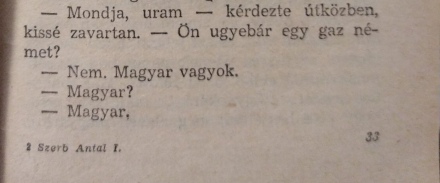
Let me wrap up this post with this: although en dashes are used for dialogues in my language, you can find em dashes used for the same purpose in older books and newspapers. Here is a part of the dialogue above, printed in the 1964 release:
ℹ️ The book I quoted above has a special place in my heart.
It is the first novel by Antal Szerb, a Hungarian author and scholar. His essays are as compelling as his novels and short stories, thanks to his kind, lighthearted humor and his ability to capture the essence of complex things into clear, accessible prose.
Although he traveled a lot across Europe earlier in his life, he chose to remain in Hungary during the 1940s and was beaten to death by fascists in a concentration camp.
Unlike him, the book’s protagonist moves to London in the 1930s to avoid the rise of fascism. Like Szerb, however, he is a literary scholar. Driven by his passion for old manuscripts, he travels to Wales, where he unravels an assassination attempt and solves a murder.